
Handing over a service business historically meant transferring physical keys, introducing the new owner to clients in person, and passing along physical ledgers. Today, business assets are largely digital, and client access is among the most heavily relied upon. When a service company changes ownership, ensuring client-access continuity, clarifying software administrator ownership, and establishing a secure credential inventory are important steps. During a service-business transition, customer service automation can help preserve response continuity while access, ownership, and complex customer decisions remain clearly assigned.
Service businesses—whether they operate as managed IT service providers, digital marketing agencies, specialized accounting firms, or strategic consultancies—depend entirely on continuous access to client environments. A disruption in this access halts day-to-day operations and damages client trust. Therefore, modern business transitions benefit from a thoughtfully structured client-access file. This file acts as a record and governance framework designed to pass digital systems from the outgoing seller to the incoming buyer.

Importantly, the client-access file should act as an architectural map, not a vault. It should document systems, roles, owners, recovery paths, and transfer procedures. Actual passwords, API keys, and recovery codes must stay in a secure password manager or approved escrow process and must not be copied into the document itself.
This guide outlines the components of a client-access file, why service businesses should prioritize its creation before an ownership transition occurs, and how to structure it to protect the seller and buyer alike.
The Shift to Digital Continuity
In service-oriented industries, the value of the business is tied to its ongoing client relationships and the digital systems used to manage and deliver upon those relationships. While historical financial records, tax returns, and standard operating procedures outline the company’s past, active client access represents ongoing operations. Without this access, the service cannot be delivered, and revenue ceases.
Digital continuity refers to the uninterrupted operation of digital services, communication channels, and access rights during a period of organizational change. During an ownership transition, clients should ideally notice no difference in service delivery. Behind the scenes, the digital infrastructure must shift from one administrative entity to another. If the transition of digital access is poorly managed, clients may experience service lockouts or delayed project communications.
Organizations like the Cybersecurity and Infrastructure Security Agency (CISA) emphasize that robust identity and access management supports operational security. In an acquisition or sale, this translates to the secure transfer of digital identities from the seller to the buyer.
Without a strategy for digital continuity, an ownership transition can become an operational chokepoint. When analyzing successful ownership transitions, experienced Indiana business brokers note that seamless digital handoffs are as important as transferring physical assets. By planning for digital continuity, sellers protect the business’s operations and ensure the incoming team can function immediately.
Unpacking the Architecture of the Client-Access File
A client-access file maps the digital footprint of the service business. Its primary purpose is to delineate how the company interacts with its clients’ digital environments and what tools are required to sustain those interactions on a daily basis.

This file acts as a structural blueprint for the company’s digital operations. It categorizes access into logical tiers: internal operational access, direct client environment access, and third-party vendor access. Internal access covers the productivity and project management tools the team uses to collaborate on deliverables. Client environment access covers the direct connections needed to manage client resources, such as content management systems, advertising accounts, or secure file transfer protocols. Vendor access covers the tools the business licenses to perform its services, including specialized analytics platforms and industry-specific software suites.
Structuring the client-access file in this manner provides buyers with a clear understanding of the digital ecosystem they are acquiring. This approach reduces friction during due diligence by demonstrating that the digital infrastructure is logically organized and governed. Furthermore, having these tiers mapped out ensures that the incoming management team can audit user roles and permissions effectively from day one.
Identifying and Securing Software Administrator Ownership
A challenge during service business handoffs is the ambiguity surrounding software administrator ownership. Over years of operation, it is common for various employees, contractors, or former business partners to hold administrative rights to software platforms. These platforms include customer relationship management systems, enterprise resource planning tools, and cloud storage environments.
Before an ownership transition, the current owner should conduct an audit to identify who holds administrative privileges across all platforms. The client-access file documents these roles, distinguishing between billing administrators, technical administrators, and operational administrators.
The business then consolidates these administrative rights into an owner-controlled framework. Leaving administrative access in the hands of departing personnel creates security risks. The new owner must inherit a clear line of control over the digital infrastructure. This means transferring root access, updating primary billing contacts, and ensuring that no system depends on a single employee’s user account. Clarifying software administrator ownership streamlines the transition process and reduces the risk of unauthorized access post-sale.
The Credential Inventory Map
At the heart of the client-access file is the credential inventory map. As emphasized above, the file itself does not contain passwords. Instead, it serves to map the systems, identifying the purpose of each account, the level of access it grants, the associated clients, the designated system owners, and the authentication protocols in place. Actual credentials, complex API keys, recovery codes, and secure database passwords remain entirely within an encrypted password manager or established digital escrow. The client-access file should explicitly outline recovery paths and transfer procedures for these secure vaults.
Following frameworks from authorities like the National Institute of Standards and Technology (NIST), effective access control necessitates that organizations maintain visibility over who has access to what resources. This principle is especially applicable during corporate transitions, where the risk of lost access or unauthorized entry is elevated.
During an ownership transition, the credential inventory serves as a structural guide. The physical or digital transfer of the actual credentials should occur only through enterprise-grade, encrypted password management systems. The client-access file details the architecture of this credential management system, explaining how access is partitioned into shared and private vaults, and outlining the methodology by which the new owner can assume control, rotate credentials securely, and issue new access protocols to the incoming management team without causing service interruptions.
Preserving Control over Client Communication Channels
Communication binds a service business to its clients. Therefore, preserving control over client communication channels is an aspect of the client-access file. This encompasses managing the transition of the primary corporate messaging system, social media accounts, client portal systems, marketing platforms, and unified telephony systems.
In service businesses, individual account managers may establish direct communication channels with key clients. The client-access file maps out official and unofficial communication conduits. The goal is to ensure the new owner retains centralized control over how and where the company communicates with its client base.
Transitioning communication channels requires step-by-step planning. Infrastructure such as domain registrars, DNS records, and overall hosting environments must be transferred to the buyer’s control. The administrative rights to social media profiles and marketing automation platforms must be updated to reflect the new ownership and remove former stakeholders. If client communication is interrupted, the transition is compromised. A client-access file ensures that the new owner holds the keys to all client dialogue from day one.
Managing Vendor and Third-Party Access Integrations
Service businesses rely on an interconnected ecosystem of vendors, third-party software applications, and digital tool integrations. Often, these third-party tools are granted deep access to client data, internal communication systems, and core platforms via API connections or secure authentication tokens. Documentation of these vendor relationships, billing cycles, and their corresponding access rights is an essential component of the client-access file.
When ownership changes hands, vendor agreements frequently need to be formally reassigned, billing details updated, and access permissions reviewed. The client-access file includes a precise inventory of third-party integrations, detailing what specific data points they access, what permissions they hold, and why they are necessary for ongoing operations. For example, if a marketing agency uses an automated reporting tool that pulls data directly from a client’s analytics dashboard, the file must document the nature of that API connection and the procedures for updating its ownership.
The incoming owner needs clarity on exactly which external entities have a digital footprint within the company’s infrastructure. Documenting these integrations facilitates a smoother technical audit during due diligence and ensures third-party access is actively managed during the transitional period. This visibility also allows the new owner to identify redundant software subscriptions or integrations that could be consolidated post-sale.
Overcoming Pitfalls During the Digital Handoff
The handoff process can involve technical and logistical challenges. One common pitfall involves Multi-Factor Authentication setups. A business owner might tie system authentication tokens to their personal mobile device. When the business is sold, transitioning these tokens can be disruptive if not planned for in advance. The client-access file outlines a migration path to corporate-controlled authentication solutions, ensuring the new owner is self-sufficient after closing.
Another pitfall is the failure to transfer proprietary software licenses. Some software vendors require written permission to transfer a license between corporate entities. If the seller waits until closing to attempt this, the buyer may find themselves locked out of operational software. The client-access file identifies non-transferable or complex software licenses and outlines the steps to resolve them before the transition date.
Actionable Continuity Checklist for Sellers
To ensure the client-access file is actionable and effective, service business owners should follow a structured approach before officially listing the business for sale. The following checklist provides steps for establishing digital continuity:
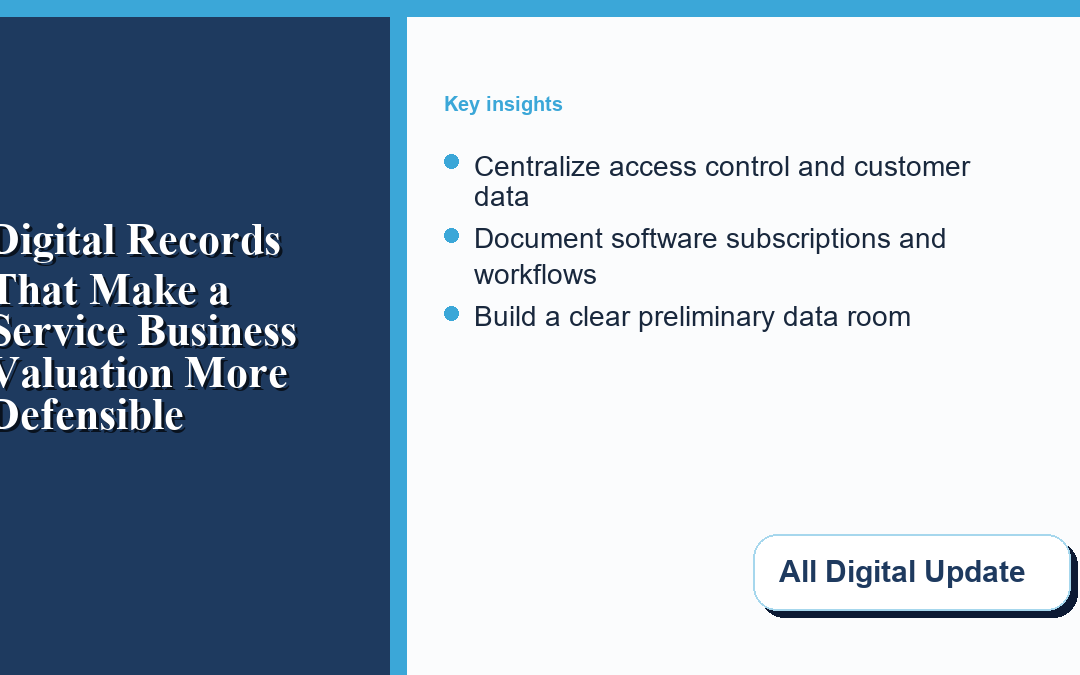
- Audit Administrative Privileges: Identify every internal system, client platform, and vendor application. Document who holds top-level administrative access and consolidate this access under an owner-controlled framework.
- Secure the Master Credentials: Implement an enterprise password management solution. Ensure all credentials and API keys are securely stored. Review the file to verify that actual passwords are omitted, leaving only structural mapping, roles, and transfer procedures.
- Centralize Client Communications: Review every communication channel, including messaging systems, client portals, and social media accounts. Verify that the company entity holds administrative rights.
- Map Third-Party Integrations: Create a list of all software integrations and vendor access points. Document the operational purpose of each integration and the scope of data it interacts with.
- Implement Corporate-Level Access Controls: Audit all authentication setups. Ensure secondary login requirements for systems are tied to corporate resources, such as a dedicated physical security key or a corporate-controlled application, rather than private devices.
- Document Access Procedures: Write step-by-step procedures for granting, modifying, and revoking access to internal systems and client environments. Ensure these procedures address both employee offboarding and client onboarding.
- Plan the Secure Handoff Protocol: Establish an encrypted method for transferring the master credential inventory to the new owner upon the finalization of the business transition. Include steps for verifying recovery paths with the new administrative team.
Navigating the Client-Access Handoff Smoothly
The execution of handing over digital control should be executed methodically, typically in distinct phases, to minimize operational disruption.

Initially, during a transitional training period, the new owner is generally granted co-administrative access alongside the outgoing owner. This phase allows the incoming team to verify the contents of the client-access file, test logins, and understand the digital architecture of the acquired business. System access logs can be monitored to confirm that access is functioning exactly as expected.
Once the new owner is comfortable navigating the digital environment and the transition period concludes, the outgoing owner’s access is systematically revoked. This revocation includes rotating root passwords within the secure password manager, updating secondary login protocols to the new owner’s devices, removing the outgoing owner from vendor portals, and updating technical registrar contacts. A smooth handoff requires transparency and adherence to the procedures documented in the client-access file.
Conclusion
In the service economy, digital assets and access rights are as important as physical infrastructure or financial capital. For a service business undergoing an ownership transition, the transfer of digital access ensures a smooth handover.
The client-access file is a strategic framework. It maps digital continuity, secures software administrator ownership, outlines the credential inventory, and manages client communications.
By organizing and documenting this digital infrastructure, service business owners protect their client relationships and ensure continuous service delivery. Creating a client-access file takes effort and auditing, but it prepares a business for sale. It safeguards the operational integrity of the business during its transitional period and provides the incoming owner with the foundation needed to lead the company forward.


0 Comments