
What Digital Records Belong in a Buyer Review
When assessing a service business for a potential acquisition, operators and advisors often begin by scrutinizing financial statements, tax returns, and client contracts. Financial records inform valuation and help establish economic performance, but they may not show how the business functions day to day. Digital records and systems can provide useful evidence about the processes that power service delivery. If you are preparing to buy an existing business, looking closely at these digital footprints is an important part of assessing operational continuity.
Digital records encompass systems of truth a company uses to operate efficiently. This includes CRM databases, dispatch logs, field service app data, and digital work order histories. Thorough buyer reviews should seek concrete evidence within these platforms. An owner might claim a ninety percent customer retention rate, but if the CRM shows fragmented contact histories and no standardized follow-up sequences, retention might depend heavily on the owner’s personal relationships rather than transferable processes.
The goal at this stage is to compare the available operational evidence with the seller’s pitch. This step supports filtering through initial listing representations without getting bogged down by bad fits. Service businesses often depend on routing efficiency and historical service data. If digital records are incomplete or inaccessible, the buyer may struggle to assess whether customer continuity can survive an ownership change. Properly maintained records can indicate that the business has institutional memory beyond one person’s recollection.
Moreover, digital records establish a baseline for post-acquisition integration. Buyers intending to implement new software or scale operations benefit from understanding existing data architecture. Reviewing the digital ecosystem early can surface integration costs, gaps, and priorities before the transition plan is set.
For a service-company transaction, owners and buyers benefit when the operating record is organized before diligence begins. This Indiana plumbing business valuation and exit-planning guide shows the owner-side preparation that makes those records easier to review.
Review Access, Data, and Operating Workflows
Understanding what digital records to look for is only the first part of the diligence process; the second phase involves assessing how those records are accessed, secured, and utilized in daily workflows. A service business is only as resilient as the digital infrastructure supporting its staff. When reviewing these systems, prioritize three main pillars: data integrity, access management, and workflow continuity.
Data integrity refers to the accuracy, completeness, and exportability of data. A buyer should request raw data exports of recent work orders and dispatch schedules. Are technicians updating software in real time, or is the office manager batch-entering data from handwritten notes? The latter creates more opportunities for error and may signal a workflow bottleneck. Buyers should also verify whether the data can be exported in a usable format, such as CSV or SQL, if the new team later needs to migrate systems.
Access management and security represent another important investigation area. Buyers should evaluate the permissions architecture within the company’s software. Do individual employees have their own logins? Are administrative privileges restricted to key personnel? Federal cybersecurity guidance recommends multi-factor authentication (MFA) for access to sensitive operational and customer data. If a business lacks MFA or role-based access controls, that is a vulnerability to address as part of the transition plan.
Finally, operating workflows should be mapped against the software being used. Diligence should uncover how a request travels from an inbound call to the final invoicing software. Breaks in this digital chain—where data is manually transcribed—can reveal inefficiencies. Additionally, a buyer should assess device management protocols. Reviewing how to protect data stored on devices can provide a framework for evaluating whether the seller has adequately secured customer information against physical loss. Relying on unsecured personal devices for dispatch is an operational risk to assess.
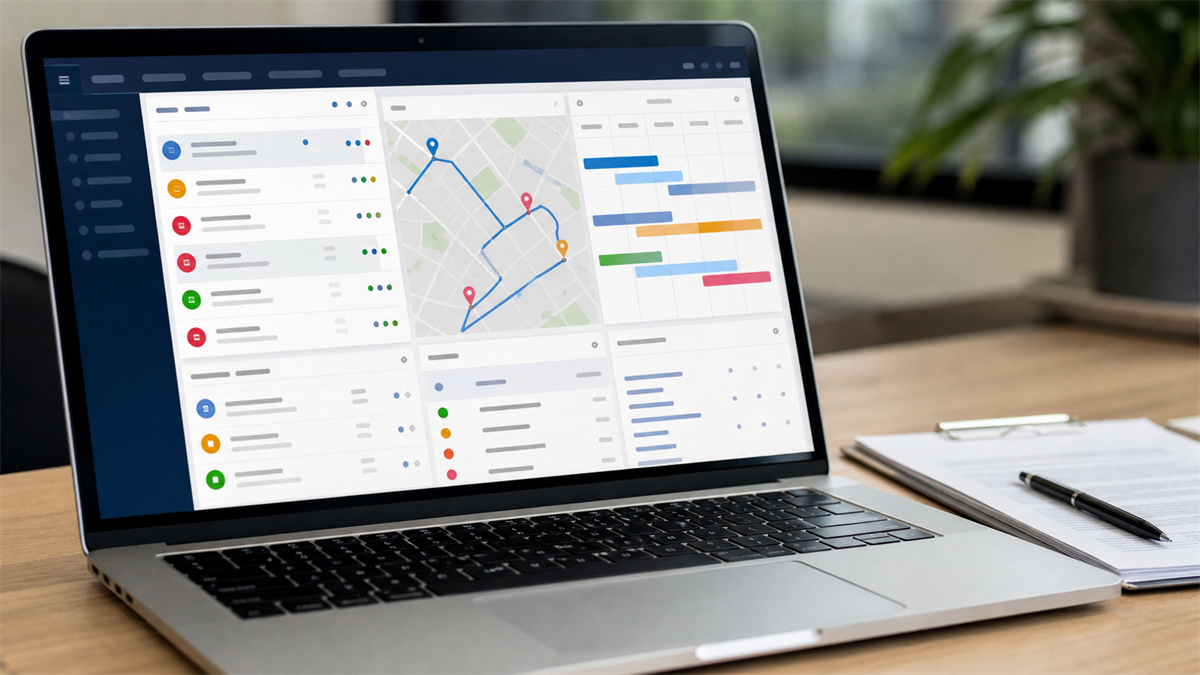
Evidence Table for a Practical Diligence Review
To systemize the review of digital operations, buyers should utilize a structured approach. The following table provides a framework for categorizing evidence, understanding where to look, and distinguishing between healthy operational signs and structural risks.
| Evidence Category | System/Source | What to Verify | Green Flags (Healthy Operation) | Red Flags (Structural Risks) |
|---|---|---|---|---|
| Customer History & CRM | Salesforce, HubSpot, ServiceTitan, Jobber | Completeness of customer profiles, service history logs, and communication records. | Detailed notes on past services, equipment models documented, consistent tagging. | Blank fields, no service history beyond invoice total, reliance on “Rolodex” knowledge. |
| Dispatch & Scheduling | Field Service Management (FSM) software, Digital Calendars | How technicians are routed, time-tracking accuracy, and emergency response workflows. | GPS tracking utilization, real-time status updates by field workers. | Heavy reliance on SMS threads for dispatching, frequent double-bookings. |
| Access & Security Controls | Active Directory, Password Managers (1Password, LastPass), Software Admin Panels | User permissions, offboarding protocols, and authentication requirements. | Role-based access (least privilege), MFA enabled, clear logs of ex-employee access being revoked promptly. | Shared “[email protected]” credentials, sticky notes with passwords, ex-employees still active in the system. |
| Financial & Invoicing Workflows | QuickBooks Online, Xero, integrated payment gateways | Synchronization between the field service software and the core accounting platform. | Automated invoice generation upon job completion, digital payment capture in the field, clean AR aging reports. | Manual batch imports requiring days to process, mismatched revenue figures between CRM and accounting software. |
| Standard Operating Procedures (SOPs) | Notion, Google Workspace, Microsoft SharePoint, internal wikis | Documentation of routine tasks, software training guides, and troubleshooting steps. | Updated, version-controlled documents, video walkthroughs, easy searchability for new hires. | SOPs stored locally on a single desktop, outdated documentation, complete absence of written processes. |

How to Use Findings Without Overstating Them
Gathering this evidence is useful, but buyers should interpret findings appropriately. It is common for a small-to-medium service business to have some gaps in digital hygiene. The objective of this review is not to find a perfect company, but to estimate the likely scope of the operational debt being acquired. Overreacting to a messy CRM can cause a buyer to walk away from an otherwise fundamentally sound and profitable enterprise.
When discrepancies or inefficiencies are discovered, they should be viewed as transition action items rather than automatic dealbreakers. If a business uses outdated server-based software instead of a cloud solution, the transition plan may need to budget for software migration and staff retraining. These findings can also be useful when assessing tools designed to compare regional business opportunities side by side. A business with slightly lower margins but well-maintained digital records might be a stronger acquisition target than a higher-margin business that requires a complete technological overhaul.
Furthermore, findings from the digital diligence process can be leveraged during final negotiations tactfully. If the customer database cannot be cleanly exported and may require expensive manual data entry to modernize, a buyer might justifiably negotiate a slight reduction in the purchase price to offset this immediate capital expenditure. However, buyers should avoid using minor digital flaws as a bludgeon against the seller. The seller built the business to its current profitable state using existing methods, even if those methods seem archaic.
Ultimately, a pragmatic buyer uses the digital records review to build a post-closing playbook. By knowing how the data flows, who has access to what, and where workflow bottlenecks exist, the new owner can begin with a prioritized list of operational improvements and a more informed path to scalable growth.
Frequently Asked Questions
Digital operations records are the electronic logs, databases, and systems—such as CRMs, dispatch software, and digital work orders—that a service business uses to track daily activities, manage customer relationships, and execute its workflows.
Financial statements show the past profitability of a business, but digital operations records can help show how the business functions. They provide evidence about whether the company’s success is supported by repeatable workflows rather than only the owner’s personal efforts.
A common red flag is shared login credentials and a lack of multi-factor authentication (MFA). This can make it difficult to audit employee actions or revoke access during offboarding.
Buyers should not automatically walk away from poor digital hygiene. Instead, they should quantify the cost and effort required to modernize the systems, potentially using these findings to adjust the purchase price or build a prioritized 100-day transition plan.
Yes. If the review uncovers technological debt—such as data that is difficult to export, outdated software, or security vulnerabilities—the buyer may use the expected transition costs in price discussions.



0 Comments